
“This thoughtful pianist has enriched the instrument’s repertoire considerably”
News
Bruce Levingston releases 11th solo album The Elastic Heart of Youth to Critical Acclaim
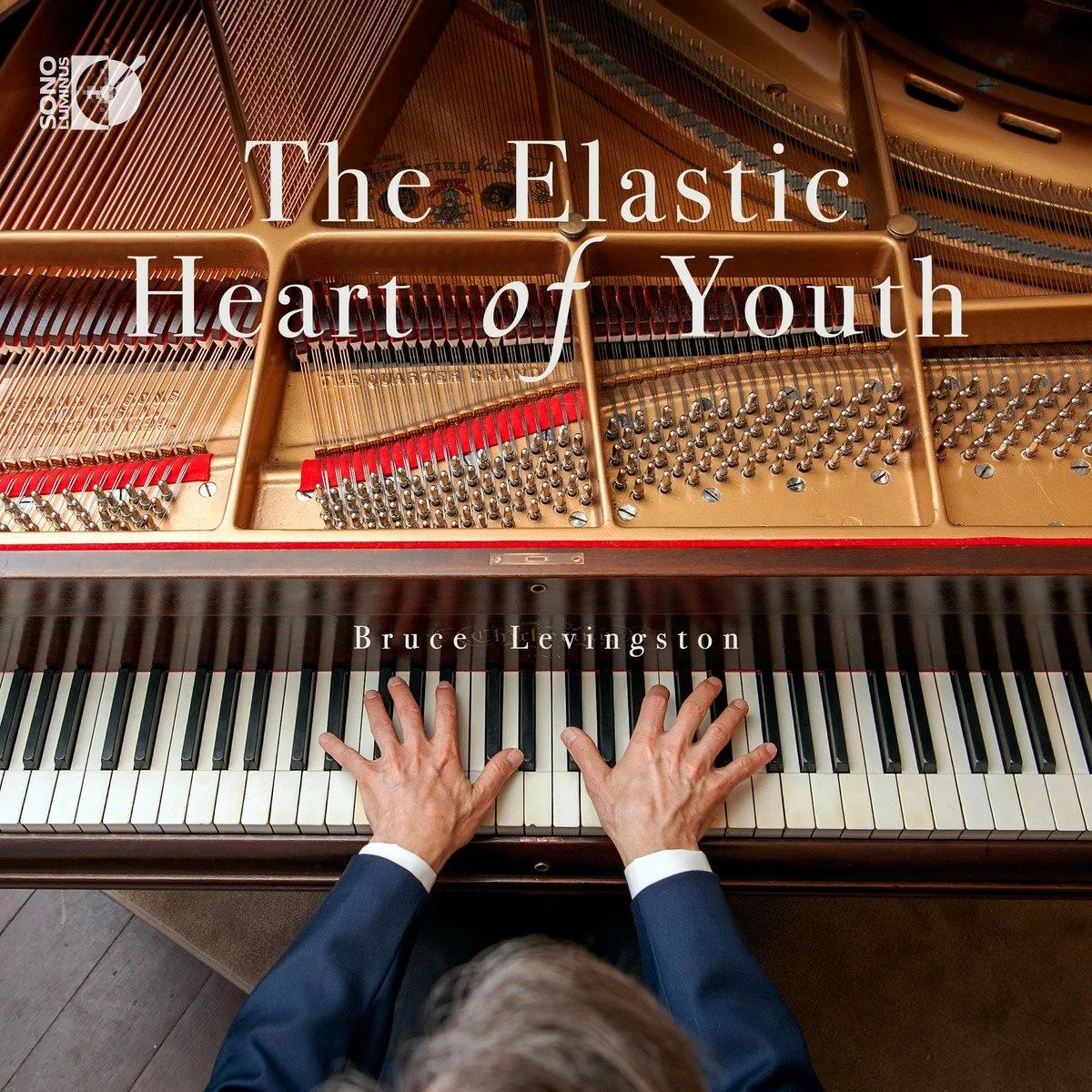
In April 2026, Bruce Levingston released The Elastic Heart of Youth on Sono Luminus, his eleventh solo album, to critical acclaim. AllMusic named it an Editors’ Choice in September 2026.
“This pianist captures the flexibility of the human heart with refined and sincere interpretations of these diverse pieces.”
— Jane Harrison, AllMusic
“...virtuosic command of the keyboard ... Levingston’s pianistic mastery is at its height here ... Levingston enables the music of these seven composers to speak to us with eloquence and poise.”
— textura
“The always impressive pianist Bruce Levingston interprets the work of Jean Sibelius, Leoš Janáček, Augusta Gross, Claude Debussy, W. A. Mozart, Domenico Scarlatti and Missy Mazzoli ... nothing short of stunning.”
— Take Effect
“All of the album’s ideas come together in a celebration of life ... works by Claude Debussy take us to a world of light and colour ... Levingston’s new album is one that makes us think.”
— Interlude
From the Preface to Levingston’s program notes for the album:
“If we understood the world, we would realize that there is a logic of harmony underlying its manifold apparent dissonances.”
— Jean Sibelius, in 1907, in conversation with Gustav Mahler
Originating in distinct musical dialects — Baroque, Classical, Nordic, Slavic, French, and contemporary — the works recorded here are bound together by a vivid, elastic heart: a profound spirit of vitality that endures through tension and release, stillness and motion, loss and restoration. Beneath their differing voices beats a kindred pulse shared with the natural world.
Sibelius’s Le Sapin evokes the spruce’s calm and poise, its hushed sonorities suggesting their own logic of repose. Janáček’s Sonata 1.X.1905 bears witness — urgent, searching, unafraid—its broken arcs invoking the dissonances of modernity’s estrangement from nature and the fragile openings through which rebirth begins. Debussy’s Étude pour les arpèges composés and La fille aux cheveux de lin shimmer with shifting light and color, while Clair de lune unfolds in the moon’s tender chiaroscuro, a meditation of light, shadow, and serenity. Mozart’s Fantasy in D minor restores grace and clarity not by denying shadow, but by transfiguring it; its improvisatory nature finds form through discovery. Scarlatti’s sonatas dance with quick, inventive pulse: sunlight on stone, castanets crossing through the air. Their brilliance is youthful joy tempered by seasoned experience.
Gross’s Solace turns inward towards repose. Here the heart practices a different virtuosity — the courage to be calm, to let resonance and renewal begin. Even in this quietude, her music recalls nature’s adaptability, its patient recalibrations in the face of change. Missy Mazzoli’s The Elastic Heart of Youth gathers all these energies into a radiant celebration of life. Its tensile rhythms and glowing harmonies echo the supple strength of the living world—the capacity to bend, to adapt, to begin again.
Bruce Levingston releases 10th solo album Without Words to Critical Acclaim
In 2023, Bruce Levingston released Without Words, his tenth solo album, to critical acclaim.

“Flawless... Levingston is one of today’s most streamed classical artists and it’s clear to see why; his mastery of his instrument is awe-inspiring...”
— Take Effect
“A new recording by American pianist Bruce Levingston makes us rethink Mendelssohn’s creation.... improvisatory and magical all at once…. Bruce Levingston’s performance captures both the poignancy of Walden’s commission and the ways that Mendelssohn wrote for his different audiences.”
— Interlude
“Exquisite material exquisitely performed... executed with consummate poise. No song is lovelier than the closing “Lullaby,” which Levingston imbues with a heartrending tenderness. That he’s as respected a writer as he is is a pianist is borne out by his astute commentaries on the works presented.”
— textura (Top 20 albums of 2023 )
From the Preface to Levingston’s program notes for the album:
“There is so much talk about music, yet so little is said. I believe words do not suffice for such a purpose. People often complain that music is too ambiguous. With me it is exactly the reverse... the thoughts which are expressed to me by music that I love are not too indefinite to be put into words, but on the contrary, too definite.”
— Felix Mendelssohn, from an 1842 letter discussing his Songs without Words
Mendelssohn’s Songs without Words defy description. Refined and nuanced, they include some of the composer's finest yet least-known works. For nearly two centuries, they were regarded as charming relics, select romantic gems performed in small concert halls and salons. Their ethereal qualities shine brightest in more intimate settings. Still, their interpretive and technical demands are considerable, requiring skillful voicing, fingering, pedaling and dynamic control. Meant to enchant rather than dazzle, they evoke myriad dreams revealing some of the composer's innermost reflections. Like private entries in a musical diary, they offer a rare glimpse into this reserved but passionate artist's thoughts.
In recent years, Mendelssohn's Songs without Words lived on my piano. Amidst turbulent societal change, these miniature masterpieces remain a source of solace and peace. At the height of the pandemic, a high school friend – an M.D. treating Covid patients – reached out. He wished to fund a beautiful memorial to those lost and those fighting the disease. With his generous support, I commissioned Price Walden, a longtime admirer of Mendelssohn’s Songs without Words, to compose a new set reflecting upon our era. Upon hearing Walden’s seven splendid pieces, I selected fourteen of the finest works from Mendelssohn's collection—seven to precede the new cycle and seven to follow.
A superb watercolorist, Mendelssohn displays his mastery of line and color throughout these exquisite tone poems. Resonant with allusions to many of Mendelssohn's Songs with Words, Walden’s cycle ventures beyond its source to imagine a new and inspired tonal canvas. Through their music, both composers – in conversation across two centuries – explore the realms of memory, nature, joy, anguish, loss, gratitude, and love – eloquently communicating in a shared language too definite for words.